
Deed Types in Saline County
The deed's label tells you why Saline County land changed hands. A warranty deed, quitclaim deed, or sheriff's deed each carries a different promise and purpose. Always read the full instrument before you draw conclusions. A deed records a transfer. A mortgage or lien documents a claim against the property instead.
| Deed Type | What It Does | Common Use |
|---|---|---|
| Warranty deed | Conveys the described interest with stated title covenants | An ordinary arm's-length conveyance |
| Quitclaim deed | Conveys whatever interest the grantor may hold | Family changes or clearing a possible claim |
| Administrator or executor deed | Transfers through an estate representative's authority | Probate administration |
| Sheriff deed | Records a conveyance tied to a judicial sale | Foreclosure process |
| Tax deed | Records a transfer following the applicable tax process | Delinquent-tax property |
The Register records far more than sale deeds. Patents, leases, easements, surveys, plats, mortgages, assignments, discharges, and several lien types all appear in the Saline County property records. These instruments can shape use or claims without conveying ownership outright. Match the legal description across every document you review.
Saline County's iDoc Search Route
The county real-estate hub points searchers to iDoc Market for online Saline County deed records. Registration is free. From there, the service offers a day pass or a subscription, depending on how the participating county is set up, and search and print charges show up in the account flow. The exact search fields, image dates, and any public online cutoff are not visible until you authenticate.
Treat iDoc as the county-linked route to Saline County property records, not proof that every deed image is online. The Register notes that deeds and miscellaneous records were entered into a computer prior to 1995, but that entry work does not set a public-image start date. The iDoc Market landing page displays the county selection and the access model.
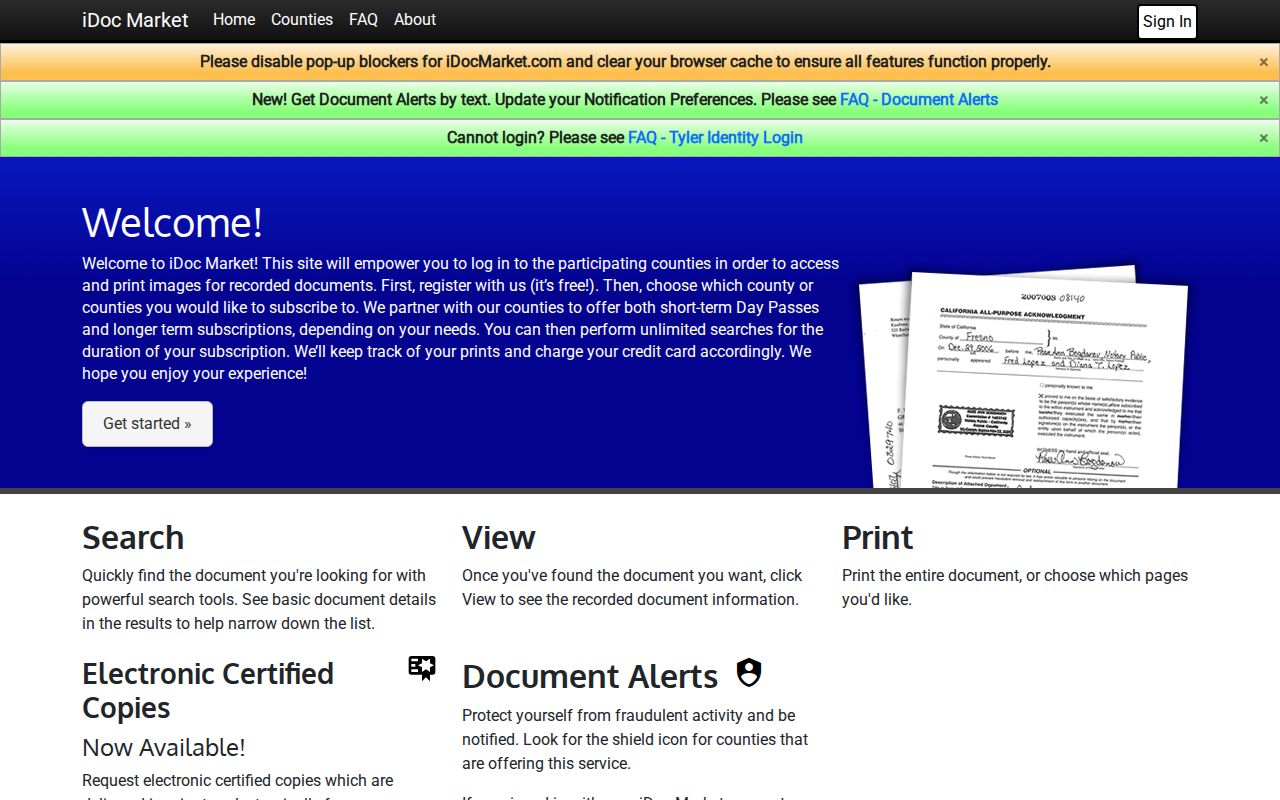
That landing screen is only the doorway. Confirm Saline County coverage and current costs after selecting the county, or contact Room 212 at the courthouse for details.
Follow Saline County Grantors and Grantees
Deed records live and die by parties. The grantor gives up an interest. The grantee receives it. Start from the most recent known owner and work backward one recorded Saline County transfer at a time, holding the land description fixed throughout the search.
- Find the present parcel owner in the Appraiser record and copy the full legal description.
- Search that owner as a grantee and identify the deed by its land description and date.
- Read the grantor's name, then search that person or entity as a grantee for the prior acquisition.
- Record each document date, recording date, deed type, and book/page or instrument reference.
- Use office-held deed books, microfilm, plats, and archival sources when the online trail ends.
- Grantor
- The party that transfers the stated interest.
- Grantee
- The party that receives the stated interest.
- Chain of title
- The ordered sequence of recorded conveyances affecting the same land.
- Book/page
- A volume and page citation used to retrieve a recorded document.
- Instrument number
- A separate identifier assigned to an individual recording.
A name alone makes a weak match. Capacity, business suffixes, initials, marital wording, and estate roles all shift between Saline County deed records, so lean on the legal description and related instrument references to keep the chain coherent.
Saline Mortgages and Releases
Mortgages share the recorder's index with Saline County deeds. But they secure debt rather than transfer ownership. Read them in order, like a timeline. An assignment moves the recorded mortgage interest to a new holder. A discharge or release shows that an earlier claim was resolved.
Link each release to the right mortgage by recording reference and land description. A similar borrower name is not enough. Mechanics' liens, tax liens, lis pendens, leases, and agreements can appear in the same property search trail.
Saline Plats Preserved Since 1863
Saline County plats reach back to 1863. The Register reports a careful preservation project around them: incubation, de-acidification, cleaning, repair, and new plat books with protective sleeves. That is why an early subdivision source may be a physical office artifact. It may not be a GIS map layer at all.
Plats, surveys, easements, dedications, and rights-of-way clarify the legal description inside a deed. Salina's original townsite plat places the townsite in parts of Sections 12 and 13, Township 14 South, Range 3 West. It also lays out the blocks, lots, and streets. Treat the map as context. The recorded final plat and the deed language remain the stronger title sources for Saline County property records.
Corrected Saline County Deeds
Recording rules explain why two nearly identical Saline County deeds sometimes appear. A re-recorded document must state its reason on its face. It must correct the error. It must also be re-executed and re-acknowledged. The county treats an affidavit of document re-file as limited to specified typographical corrections.
Compare both recordings instead of discarding the first. Check signatures and acknowledgment. Check the full legal description too. Also check recording dates and any reference to the original filing. A Sales Validation Questionnaire or a valid exemption must accompany a deed. The questionnaire itself is not filed as an ordinary public record.
Kansas Sale Details Have Limits
Kansas Sales Validation Questionnaires can hold the sale price, date, classification, financing, and circumstances of the transaction. Saline County keeps each questionnaire for five years. Even so, K.S.A. 79-1437f restricts access to listed officials and eligible participants, so it is not simply an attachment to the public deed.
The recorded deed may show consideration language or an exemption on its face. Never fill a missing sale detail with a guess. Estate, gift, trust, divorce, judicial, and title-clearing transfers can all fall under statutory exemptions, and they may look nothing like a market sale in the Saline County deed records.
Older Saline County Deed Records
The county does not post an online cutoff date. Older work therefore leans on the sources that survive. The Kansas Historical Society holds a Saline County collection covering 1865 through 1917, with land tract and transfer papers from 1866 through 1893 and railroad land patents from 1865. Its plat and ownership snapshots include atlases or plat books from 1884, 1903, 1920, about 1927, and about 1972.
Treat these as finding aids and dated snapshots. They do not replace Saline County deed records. Start from the parcel's lot-block-addition or section-township-range description, then ask the Register about the deed books or microfilm that carry the chain forward. For the earliest federal or railroad origin, consult tract books and patents through KSHS before moving ahead through county conveyances.
KSHS notes that qualifying county records and plat books may circulate by interlibrary loan, generally up to two reels for four weeks, usually shipped within five business days at no fee. Its microfilm printers run 25 cents per page. Confirm the current policy and catalog item before planning a request.
When Saline Deeds Need Court Records
A deed index can mark a legal ending without explaining it. Sheriff deeds follow foreclosure judgments. Administrator and executor deeds carry out probate authority. A quiet-title judgment may settle competing claims, and a later recorded order or conveyance writes the result into the land trail. Court files fill that gap.
Search the 28th Judicial District route by parties and case details. Then compare the final order with the recorded instrument. The legal description must match. A complaint only alleges; the property effect comes from the judgment, sale confirmation, release, satisfaction, or final journal entry. Return to the Register to see what was recorded.
Request Saline County Deed Copies
The Saline County Register of Deeds sits at 300 West Ash, Room 212, Salina. It answers at 785-309-5855 on weekdays from 8 a.m. to 5 p.m. The recording cutoff is 4 p.m. Online viewing may be available through iDoc. The counter, phone, and copy request cover records or images that iDoc cannot reach.
The Kansas schedule the county links to lists $21 for the first page of a deed, mortgage, or other instrument dated January 1, 2019 or later. Each additional page costs $17. A certificate costs $13. Copy charges run $1 for the first page by fax or email. Additional pages are 25 cents each, plus stated fax or mailing charges where applicable. Confirm the current charge for the exact request.
Give the parties, document type, approximate date, legal description, and recording reference. State whether the copy must be plain or certified and how it should be delivered. The office says it can provide the last deed of record. It also says it can respond to ownership questions.
Recorded, not guaranteed. Saline County deed records show instruments accepted for recording. They do not resolve every unrecorded interest or provide a title opinion.