
Run a Saline County Property Search
Start inside the Appraiser's parcel index. It accepts an address, an owner name, or a Quick Ref ID, and it hands back the keys other offices want. The Treasurer runs on a Tax ID instead. An older deed may carry nothing but a legal description. Never force one office's identifier into another system. Copy each label exactly as its source shows it.
- Enter the address number and street in the Saline County Appraiser Parcel Search. Use fewer fields first.
- Open the matching row and record the situs address, owner name, Quick Ref, Tax ID, property number, and legal description.
- Use the owner and legal description in the county-linked recorder search when a recorded transfer is the goal.
- Match the Tax ID in the Treasurer search and check the parcel location in county GIS.
- Request a plain or certified instrument from the Register of Deeds when the index entry alone is not enough.
This sequence cuts false matches. Similar owner names, old mailing addresses, and parcels that split or combine all cause confusion. A methodical path avoids all three. Save the search date with any result you keep, because the Appraiser refreshes its index each Sunday and yesterday's match can shift.
Saline County Parcel Search Fields
The Appraiser form is unusually broad. Address searching splits into separate number and street entries, and owner names split into last and first fields. Enter Quick Ref without its leading "R." The optional filters narrow a long result set without touching the public record underneath.
| Field group | Entries available | Useful when |
|---|---|---|
| Identity | Quick Ref ID, owner last name, owner first name | An ID or exact owner is known |
| Address | Address number, street | The parcel's street location is known |
| Building | Class, style, bedrooms, basement, bathrooms, year built | Several address or name matches remain |
| Land and value | Neighborhood, acreage range, appraised amount range | A broad area or value band must be narrowed |
| Description | Section, township, range components | A rural legal description is the best clue |
The live form controls the dropdown choices. Property class, neighborhood code, and style are assessor categories rather than informal neighborhood labels, so read them as official values.
Rural Saline County Address Clues
A blank address result does not mean the parcel is missing. Saline County rural numbering follows driveway centerlines and 660-foot blocks. Some sections use different lot increments. Unit letters skip I, L, and O. The system can place a numbered site somewhere other than a reader expects. The number alone may not tell you where. Try the street without a direction or unit first. Then compare the situs address against the mapped drive location. For land outside a platted addition, the section-township-range fields do the work. Keep two facts separate: a mailing address tells where the owner receives mail. The situs address identifies where the land sits. Note: Address conventions help locate a parcel. But the deed's legal description controls the recorded land identity.
What Saline County Property Results Show
Think of the result row as a parcel passport. It links the site to the person or entity on the assessment roll and to the identifiers behind valuation and tax work. Open the parcel detail and the building, land, and appraisal fields appear. A blank field often just means the characteristic does not apply.
| Owner and address | Name, mailing address, and separate property situs or tract description |
|---|---|
| Parcel identity | Tax ID, property number, Quick Ref, property type, and neighborhood |
| Land | Legal description, acres, land method, type, frontage, and depth when applicable |
| Value | Current and previous appraised land, building, and total values by class |
| Improvements | Year built, style, area, rooms, baths, garage, condition, and component data where present |
| Comparable traits | Features the Appraiser uses to compare similar residential property |
The official test detail shows the layout. But its example values are test data, not a real Saline County parcel. A live property search may display fewer fields. It also cannot prove that every improvement is permitted. And it cannot confirm that every mapped line has been surveyed. The official parcel-detail example shows how Saline County groups these fields.
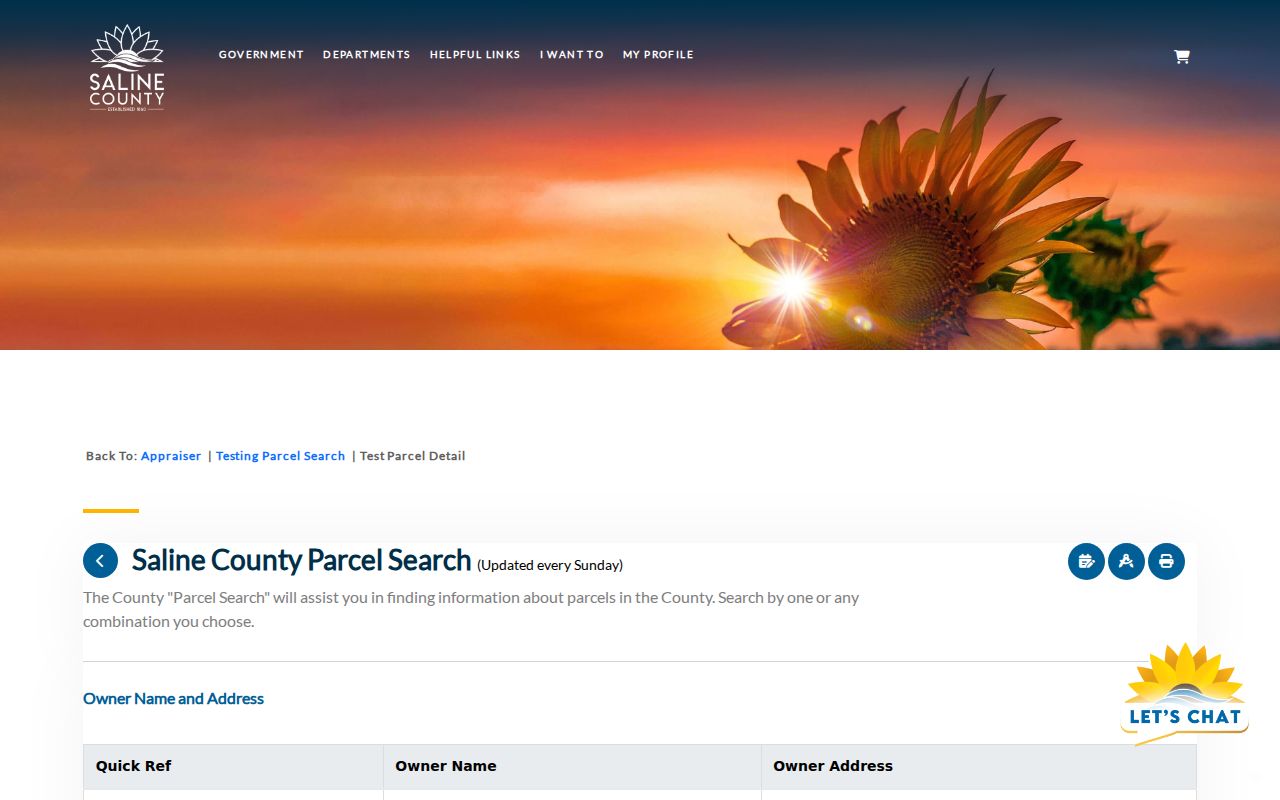
Use the screen as a field guide. Copy the actual identifiers from a live match before you move on to deeds or taxes.
Quick Ref and Tax ID Crosswalk
Saline County uses several identifiers for the same land because each office serves a different function. Quick Ref is the Appraiser's direct search key. The Tax ID connects to the Treasurer's roll. Property number and legal description separate a precise parcel when names repeat.
- Parcel or APN
- A local identifier assigned to a unit of land for assessment and mapping.
- Quick Ref
- The Appraiser lookup key, entered without the initial R.
- Situs address
- The physical location of the parcel, distinct from the owner's mailing address.
- Owner of record
- The owner name carried on the current county roll, subject to update timing.
- Legal description
- The lot-block-addition or section-township-range wording used to identify land in instruments.
An old deed may predate every current parcel identifier. Carry the legal description into the index and plat sources rather than guessing at an ID conversion.
Check Saline County Tax Results
The Treasurer search is a focused second check, not a replacement for the Appraiser. Search fields include Last Name or Company Name, Tax ID, Address Number, and Direction. Street and ZIP Code round out the options. Results return Tax ID, name, address, and legal description. The detail view adds assessed value, mill levy, and tax distribution. Taxed, paid, delinquent, and Book/Page fields appear there too. The Saline County Tax Search can confirm that the same Tax ID reached the tax roll. The legal description should match as well. The county posts no archive-year selector there. It also notes that the external detail system sits outside county maintenance. Treat tax status as its own fact. A delinquent entry is not proof that foreclosure has ended in a sale. Check Book/Page in tax detail against the recorded instrument before drawing conclusions.
Carry Saline Results Into Deeds
When you need recorded ownership, start with two things. Carry the current owner name and the full legal description into the Register of Deeds route. Saline County links to iDoc Market. Registration and a pass or subscription may be required there for searching and printing. Its exact field labels, image dates, and document coverage sit behind the authenticated flow. So plan for the counter too. Phone and copy-request access still matter when the online route stalls. Search spelling variants, entity suffixes, and trustee or estate capacity. Check both sides of a likely transfer. Capture the record date and the exact book/page or instrument label shown. The office can supply the last deed of record. It can also answer ownership questions through its contact route.
Fix a Blank Saline Property Search
A blank Saline County search usually means one filter is doing damage. Strip the extras first. An old neighborhood code, a style tag, an acreage band, or a value range can quietly push the right parcel out of the results even when the address is typed correctly. Start over with just the address number and street. Then try the surname alone. Entities work the same way. Drop the punctuation and search only the core business or trust name.
Address formats deserve a side-by-side look. A directional prefix may live in its own field. A unit letter may follow the rural convention. The mailing address can even sit outside Saline County while the situs is local. Timing bites too, because the Appraiser index refreshes each Sunday and a recent deed may not show yet. Check both the prior owner and the expected new owner before concluding the deed was never recorded.
Quick Ref failing? Remove the leading R first. A split or combination may have retired the old parcel key. When numbers fail, the legal description is the durable answer. Hand it to the Appraiser or Register of Deeds with a date range and a known party name. Some county records simply are not published online. A bounded Kansas Open Records Act request can name the address, legal description, record type, date range, and format you want. The custodian does not have to create a record or chase open-ended research.
Map the Saline County Search Match
Once the right parcel surfaces, the county ArcGIS Experience and the companion ORKA application step in. Together they give the match a geographic check. Compare the parcel shape on the GIS map. Match roads and neighboring tracts against the situs and legal-description clues on the card. Layers refresh over time. If the viewer supports a boundary or access question, save the date you accessed it.
GIS never replaces the recorded plat or a survey. A mapped line can flag that the wrong parcel row was opened. It cannot settle an easement, an encroachment, or an exact corner. When legal geometry matters, leave the mapped parcel. Move instead to final plats, surveys, easements, and deeds. Historical rural tracts may need a section-township-range search instead of a street. A city lot usually connects through addition, block, and lot.
Compare Saline County Search Keys
Pick the key that fits what you already hold. An address is quickest for one visible site. An owner name can surface multiple holdings across Saline County, and a parcel identifier is the safest handoff between matching county records. Each key still fails in its own way.
| Search Key | Best For | Where It Works | Watch Out |
|---|---|---|---|
| Street address | One known site | Appraiser, Treasurer, GIS | Direction, unit, rural numbering, or situs differences |
| Owner name | Parcels held under one name | Appraiser and recorder index | Trusts, entities, initials, and same-name owners |
| Quick Ref or Tax ID | A precise current match | Its issuing county system | Labels are not interchangeable and may change after parcel splits |
| Legal description | Deeds, plats, and older land | Recorder, archives, parcel detail | Abbreviations and replats need careful matching |
Not a title search. A Saline County property search gathers public index facts, but it does not establish clear title or replace a title professional's examination.
Broad owner searches carry a legal limit as well. Kansas restricts certain uses of name-and-address lists drawn from public records under K.S.A. 45-230, and the Appraiser requires a certification before you search. Keep the work lawful. Parcel research, purchase checks, estate work, boundary questions, and civic review all fit.