
Identify a Saline County Owner
Begin at the Saline County Appraiser Parcel Search. Accept its K.S.A. 45-220(c)(2) use statement only when the stated restriction truly applies to your search. Then enter a street number and name.
- Search the situs address and capture the owner name, mailing address, and legal description.
- Use iDoc Market to locate the newest conveyance for that land.
- Read the grantee and recording date, then check for a later correction or estate filing.
- If online access fails, ask the Register of Deeds for the last deed of record.
Compare Saline Ownership Sources
Ownership evidence in Saline County lives in more than one office. The Appraiser keeps the current owner of record and answers fast. The Register of Deeds holds the deed records that document each transfer. GIS maps locate the parcel itself. A map alone proves nothing about who holds title, so the deed records carry the real proof.
| Official source | Ownership clue | Timing limit |
|---|---|---|
| Appraiser parcel result | Name, mailing address, situs, legal description, identifiers | Updated every Sunday |
| Register of Deeds and iDoc | Latest recorded grantee and capacity | Exact online cutoff is not posted |
| Kansas business search | Entity filing and registered agent | Does not prove beneficial ownership |
| County GIS and ORKA | Mapped parcel context | Geometry is not title proof |
A mailing address is not the situs. Nor does it prove anyone lives on the parcel. A post office box, a trustee address, or an out-of-county address can still be valid for the owner of record, a label that ties a name to an official record rather than to possession.
Read the Saline Owner Field
An Appraiser result lists Situs Address, Legal Desc, Name, Address, TaxId, Property Number, Quick Ref, Property Type, Neighborhood, Acres, and Final Values. Name and Address carry the owner or mailing data. Situs Address pins down the land itself. The official sample parcel detail shows how the county lays these fields out on a parcel card.
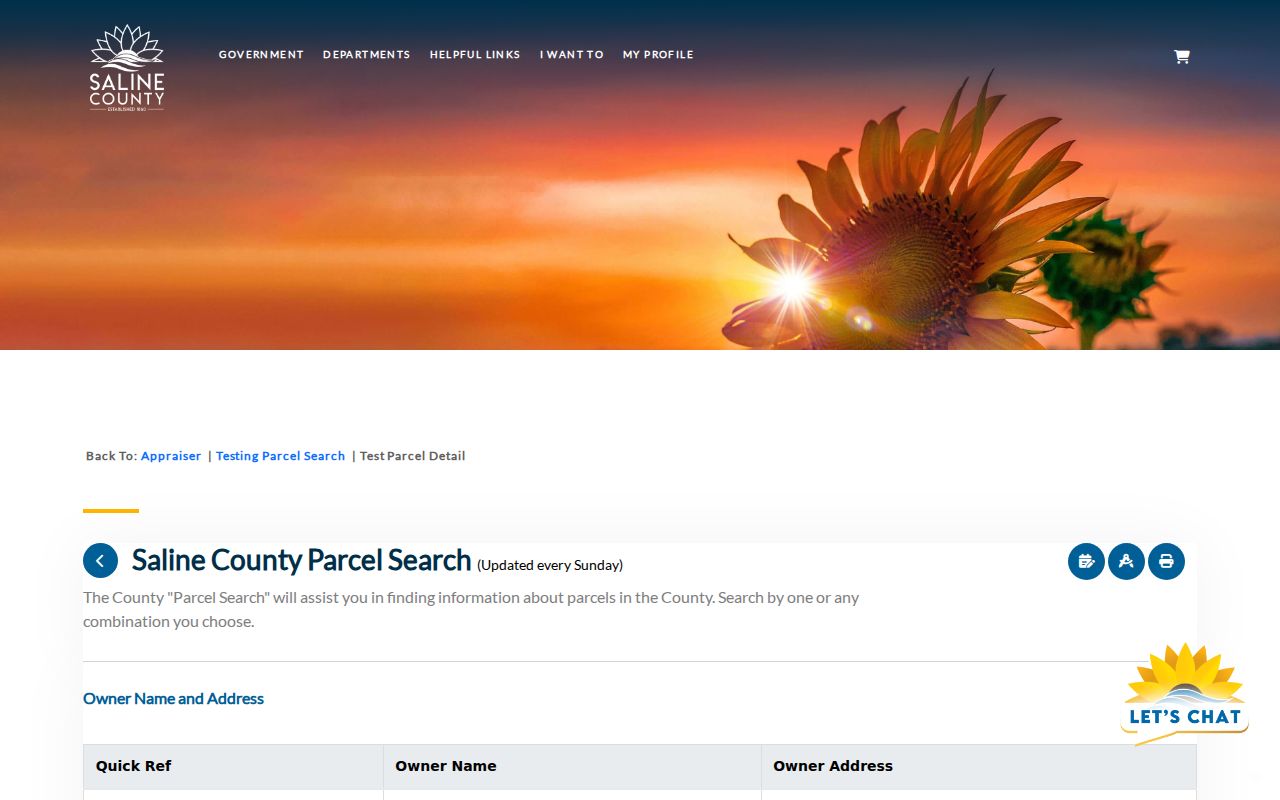
The sample parcel detail page displays field placement only, and its sample values describe no real Saline County parcel.
Trace Saline Parcel Identifiers
Quick Ref, Tax ID, and property number link the systems. Drop the leading "R." from a Quick Ref search. Keep all three, but reconcile dates through the legal description, because a split, combination, replat, annexation, or system conversion can change an identifier.
- Owner of record
- The name on a current assessment or recorded conveyance.
- Grantee
- The person or entity receiving an interest in a deed.
- Situs
- The physical property address, distinct from owner mail.
- Legal description
- The lot, block, section, range, or measured land description.
Interpret Saline Entity Owners
The owner field may hold an LLC, corporation, estate, trust, or trustee. Copy the punctuation, suffixes, and capacity wording exactly. That precision matters in a deed search. The Kansas business entity search can confirm state filings and a registered agent. But it does not disclose or prove beneficial title. Probate and court orders often explain a transfer a surname search misses. The District Court holds probate, quiet-title, foreclosure, and judgment files. Qualifying deeds and orders feed the recorded land trail.
A registered agent serves as an entity's statutory contact. That role alone proves nothing about ownership. The agent may not manage, benefit from, or occupy the parcel at all. Trust the grantee wording on the deed itself, because that is what the land record actually says about who took title. When a trustee appears, resist the urge to guess beneficiaries from a name or mailing address on the filing.
Other instruments can reroute your search entirely. A survivorship affidavit, administrator deed, sheriff deed, tax deed, or probate order may each shift who the owner of record is. Search the current entity name and prior grantee names too, but anchor every match to the legal description of the land. That discipline keeps a same-name filing from sticking to the wrong parcel.
Resolve Saline Owner Mismatches
Assessor names and deed grantees disagree more often than you might expect. The two can fall out of sync after a recent closing. A correction, estate transfer, survivorship filing, or parcel change can do the same. Saline County refreshes its appraisal data weekly. Yet it publishes no typical sale-to-roll lag. Compare dates instead of guessing which name is stale.
Pull the newest conveyance that matches the full legal description. Then hunt for a correction, affidavit, administrator deed, or court order layered on top. A tax result lets you cross-check Tax ID, address, legal description, and Book/Page. Tax status alone never proves title, though.
Note: Saline County does not post the iDoc index start year or image coverage on its public landing page.
Execution and recording dates are not the same thing. The recorded sequence shows what has actually entered the public land record. A pending transaction may simply not show up yet. A mortgage, release, or lien does not convey title to anyone. Read the instrument type and the grantee language carefully before concluding that ownership changed.
Corrections need the same care. Saline County's recording rules require a re-recording to state its reason. It must fix the error, and be re-executed and re-acknowledged. An affidavit of document re-file plays a narrower correction role. Compare the original against the correction rather than counting two hits as two sales.
Ask Saline Records Custodians
Need an image that's unavailable? Contact the Register of Deeds at 300 West Ash, Room 212, Salina. You can also call 785-309-5855. Staff can supply the last deed of record and answer ownership questions. The office is open Monday through Friday, 8 a.m. to 5 p.m. For anything beyond deed records, file a Saline County open-records request. State a bounded record type, date range, name, address, and legal description. KORA does not obligate staff to build a new ownership analysis for you.
Before requesting copies from Saline County, decide whether you need a plain or certified copy. Decide how you want it delivered, too. Include any parties or recording dates you know. That detail speeds up the search. Charges vary by service. So confirm current fees with the office or a live account rather than assuming recorder copy costs match iDoc subscription and print charges.
Parcel cards and the current assessment roll belong to the Saline County Appraiser. That office handles questions at 785-309-5800. The Treasurer is the better stop for paid, delinquent, levy, and annual tax fields. Those fields live on the tax roll. Routing each question to its custodian keeps a tax contact from being mistaken for a deed records source. It also saves you a second trip through county property records.
Retry a Saline Owner Search
A blank result rarely means no owner of record exists. Drop the street suffix. Split the house number from the name. Searching an owner as “Last Name First Name” often works better. Entity punctuation, LLC endings, and trustee wording can each shift what the parcel search returns. Rural land adds a wrinkle. The situs address may follow the driveway's centerline rather than where the house sits on an aerial view. A Saline County address that looks obvious can still miss.
Parcel history matters too. If the tract was split or combined, pull the legal description. Pull the older owner of record from the recorder. An old deed may carry no street address at all. It may list only section, township, and range, a named addition with lot and block, or metes and bounds. Before comparing names, check the Appraiser, Treasurer, GIS, and deed records. Make sure they all describe the same piece of ground.
If a consent page blocks the search, do not work around it. Go through the office or its records-request channel and state the lawful property purpose. Staff can supply an existing record. They need not build a custom owner history for you.
Limits of Saline Owner Lookups
An owner lookup answers one narrow question. It does not show who lives at an address. It does not disclose trust beneficiaries or replace a title examination. Remember that GIS lines are tax mapping, not surveyed boundaries. Blank results can come from spelling, format, access, or coverage problems rather than a true absence of property records.
Kansas Safe at Home gives qualifying survivors a substitute address. Treat a protected mailing address as valid, never as an error or a clue to a private location. K.S.A. 45-230 also limits certain uses of public lists. Keep any Saline County inquiry tied to one parcel and a legitimate deed, boundary, sale, estate, or civic question.
The Register's index is not the deed itself. An index points you toward an instrument. The instrument still has to be read: its grantee language, legal description, exceptions, and recording details carry the real answer. When liens, easements, probate, court orders, or competing claims enter the picture, a professional title search is the right step.
Property Fraud Alert offers a free name-based notice whenever a document is recorded under a registered name. It is not parcel-specific. An alert proves neither fraud nor ownership. Treat it as a prompt to pull the recorded document and contact the Register if something looks wrong.
Use records lawfully. Saline County owner data can support purchase, boundary, estate, and civic research. It must not be used to stalk, harass, or harm anyone.