
Fields in Saline County Tax Records
The Treasurer's detail page brings land identity, valuation, levy, and collection fields together in a single record. Read them in groups. Assessment work produces the value. The levy converts assessed value into a tax amount. Paid or delinquent then tells you where collection stands for the year shown.
| Field | What It Shows | Where |
|---|---|---|
| Parcel identity | Owner, address, parcel number, Tax ID, and legal description | Treasurer detail |
| Land location | Section-township-range or subdivision, block, and lot | Treasurer detail |
| Assessed value | The classified value used as the tax base | Appraiser and tax detail |
| Mill levy | The combined rate applied per thousand dollars of assessed value | Treasurer detail |
| Tax distribution | How the billed tax is allocated | Treasurer detail |
| Collection status | Taxed, paid, and delinquent fields for the displayed record | Treasurer detail |
Extra fields can appear too. These include tax unit, school district, parcel class, and a Book/Page reference. Treat that reference as a cross-check, not a stand-in for reading the deed itself. Also remember what the record is not. A tax bill is not a market appraisal. It never reports what a buyer must pay for the property.
Search Saline County Tax Fields
The Saline County Treasurer Tax Search offers several ways in. Start with one strong clue, such as a name or address. Add fields only when the result list needs narrowing. A company name goes in the same field used for an individual surname.
| Search field | Entry | Best use |
|---|---|---|
| Last Name/Company Name | Owner surname or entity name | Finding tax accounts held under a known name |
| Tax ID | County tax identifier | Returning one exact account |
| Address Number | Street number | Locating a known site |
| Direction and Street | Directional prefix and street name | Distinguishing similar addresses |
| ZIP Code | Postal code | Narrowing a common street or name |
The official tax-search screen shows the available entry fields before a result is opened.

Each result lists Tax ID, name, address, and legal description. The Treasurer publishes no archive-year selector or full statement of historical depth. So an older parcel that fails to appear warrants a request to the office, not a conclusion that no record exists.
Look Up a Saline County Tax Bill
Carry the same Tax ID and legal description from the search row to the detail screen every time. This habit matters when one owner holds several parcels. It also matters when the mailing address differs from the taxed property.
- Search the Treasurer by Tax ID, owner or company name, or the separate address fields.
- Match the result's address and legal description, then open the tax detail.
- Record the year, assessed value, mill levy, distribution, and taxed amount.
- Read paid and delinquent status as of the displayed record and save the lookup date.
- Use court, foreclosure, and deed sources before concluding that delinquency changed title.
- Appraised value
- The Appraiser's estimate of fair market value or applicable special-use value.
- Assessed value
- The classified portion of appraised value used to calculate tax.
- Mill levy
- The tax rate per $1,000 of assessed value.
- Tax lien
- A legal claim tied to unpaid tax, distinct from a completed sale.
The official tax-detail layout shows how the fields are grouped.
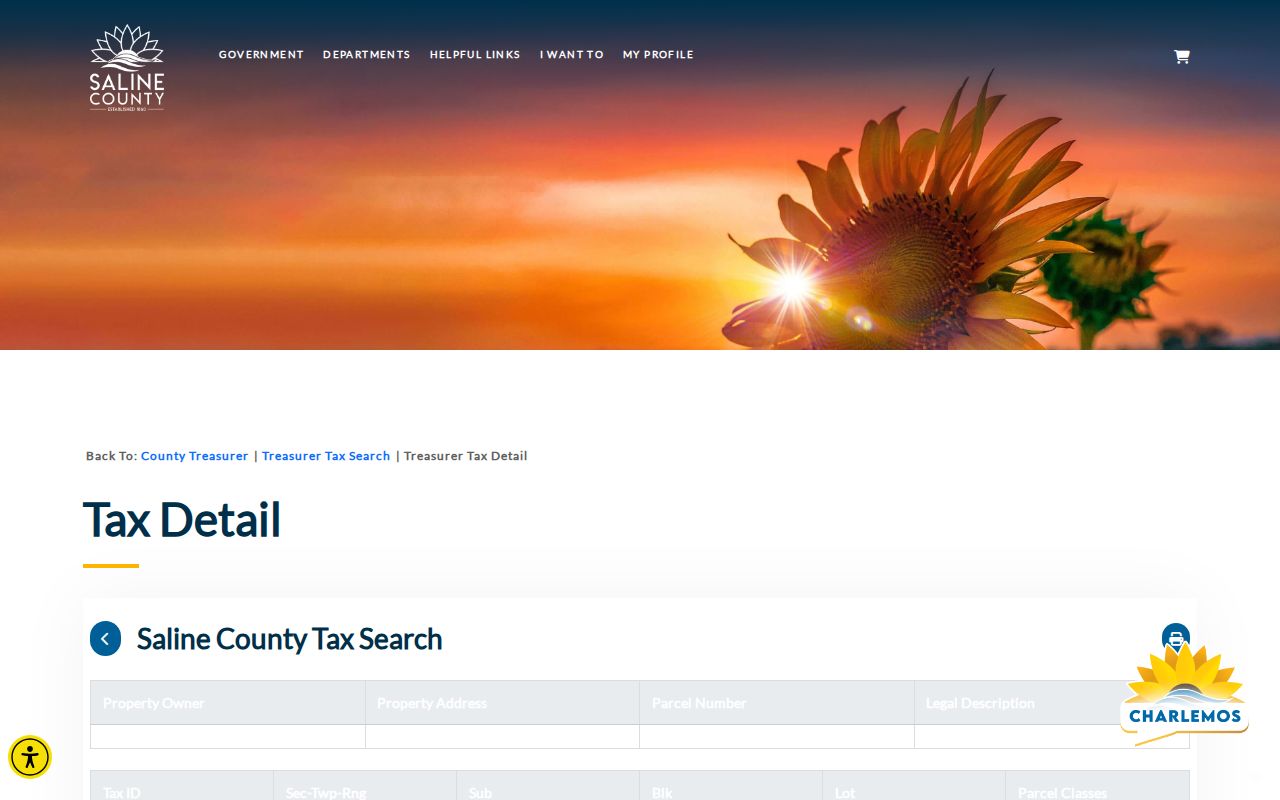
Treat the detail screen as a dated tax record, not a live guarantee. Its warning about an external system makes direct confirmation with the office the prudent step before relying on any status.
Saline County's Two-Part Tax Calendar
The Treasurer mails property tax statements in November. Each statement carries both payment stubs. The first half is due December 20. The second half is due May 10 of the following year. No second-half statement goes out. So the November mailing stays important after the first payment is made. The county does advertise a reminder-email option, but a reminder is not a record of payment. Confirm paid status with the Treasurer and keep the parcel's Tax ID at hand.
Note: Verify current county notices when weekends, holidays, or policy updates might affect processing.
Kansas Rates Behind Saline Taxes
Kansas works in steps. First comes appraised value. Then the classification rate produces assessed value. The tax equals assessed value multiplied by the mill levy and divided by 1,000. Actual use controls classification, so a mixed-use parcel can be split among classes.
State materials set the main rates. Residential sits at 11.5 percent. Commercial and industrial sit at 25 percent. Agricultural land carries a 30 percent use-value rate. Vacant lots sit at 12 percent. Public utility property sits at 33 percent. Other property sits at 30 percent. Those rates never replace the parcel record. Agricultural use value, mixed use, exemptions, and the applicable levy all call for parcel-specific review.
One Sale Does Not Set Value
Saline County's own explanation is plain. Appraisers study local sales and conditions each year. They do not create the market. The county draws on market, cost, and income approaches where each fits. Kansas also requires an exterior view or inspection every six years. No single sale sets market value on its own.
County material further separates current-year appraised values from tax information built on a prior assessed value. Check the labeled year before comparing a parcel card with a tax detail. A county-wide trend can explain broad movement in the tax roll. An individual parcel may still differ because of use, condition, size, location, or other property characteristics.
Saline Delinquency and Foreclosure Records
Paid, delinquent, taxed, and distribution fields all describe tax administration. None of them proves a court ordered a sale. None proves that title passed. For a tax-foreclosure question, pair the Treasurer result with the county's pending-sale notice, the district court case, and any recorded sheriff or tax deed.
Redemption, auction, confirmation, an unsold-property status, and the final conveyance are separate events. Match each one by Tax ID and legal description. The court outcome and the recorded instrument carry more weight than an old delinquent flag.
Verify Saline County Tax Detail
The county warns that the external tax-detail system is not maintained by Saline County. That does not make the result useless. It does mean the record is best treated as a dated access point. Payment and delinquency questions worth acting on should be confirmed with the Treasurer at 785-309-5860 or at the office in Room 214 at 300 West Ash.
Save the Tax ID, the displayed year, and the exact status language. If the year you need is not exposed online, request the statement, payment record, delinquency record, or tax-foreclosure document by parcel and date range. Kansas Open Records Act requests should seek a defined record, and the office may charge actual and authorized costs for access, staff time, review, redaction, copying, or delivery.
Build a Saline Assessment Review
Start with the parcel card, not the tax amount. Verify property class, living units, zoning, neighborhood, acreage, year built, style, area, basement, bathrooms, garage, condition, land method, and listed improvements, because one wrong fact can change which properties or cost inputs the Appraiser applies. Then compare land, building, and total values year over year.
Anchor evidence to the January 1 valuation date on the notice. Comparable sales must genuinely match in use, location, size, and condition. Photos help. So do repair facts, a recent independent appraisal, or proof a listed improvement does not exist. Each item can sharpen the informal meeting. The Appraiser's role there is analyzing market transactions uniformly, not setting prices by preference.
The parcel portal filters by class, style, bedrooms, basement, bathrooms, neighborhood, acreage, year built, and appraised amount. Those fields can surface candidates. A filtered result is not proof two properties are equal. Keep the source date, and explain every difference.
Appeal a Saline County Assessment
K.S.A. 79-1448 generally gives a taxpayer 30 days after the valuation notice to appeal to the county appraiser. The first stage includes an informal meeting. A later appeal to the Kansas Board of Tax Appeals may be available under the governing procedure.
For 2026, Saline County said values reflected the market as of January 1 and asked taxpayers to contact the Appraiser before March 31. The county described a telephone informal meeting that typically lasts about 20 minutes. Useful support addresses the property's market value, such as comparable property data, condition facts, or an error in characteristics. The amount of the tax bill is a different issue from whether appraised value is correct.
Appeal window. Use the deadline printed on the current valuation notice. The March 31 date was specific to Saline County's 2026 notice, not a permanent annual date.